Showing posts with label Cuerpo de Paz. Show all posts

Sunday, June 1, 2014

The Latte Factor

Months ago, while at chuchi (super fancy) coffee stand in an even more chuchi mall in Asunción, I decided to splurge on a 12,000 Guarani cup of coffee. This decision did not come easy. After almost five full minutes staring at the menu, weighing the pros and cons of consuming such an extravagant treat, I went for it. Oh the sweet relief when the price tag matched my dreams for this drink. It had vanilla and chocolate and a little cream and I think I may have briefly left my body while consuming it. Whatever I gave up in exchange for blowing my budget for a hot beverage on a 90 degree day did not matter. This concoction hit the spot.

I heart coffee.
Did I mention that at today’s exchange rate 12,000 Guaranis converts to two dollars and seventy-one cents in US currency?

I knew getting into this that we would live differently, radically differently. Although I never had lavish tastes, pre-Peace Corps I usually did not think twice about buying anything under twenty dollars. Now, I give pause to every item priced over ten mil- $2.26. Yet, despite this dramatic shift in tax brackets, I don’t particularly feel a loss. The things we can’t afford, we don’t need.

I’ve always tried to live simply. When we packed our home into storage before leaving for Paraguay, I realized that I may have been fooling myself. In lieu of knickknacks and brand name clothing, we indulged in music, books, and kitchen gadgets. In site, we had two bowls, four plates, three spoons, and used an empty wine bottle for a rolling pin. This is living simply. The Viking food processor waiting for me in my parent’s basement is not.

Of course, sometimes I forget we have a budget. Some days, for example while drinking wine in a restaurant in the capital, I may order a second glass without checking how much cash I have left in my wallet. The thought, though, never strays far.

People adapt to situations and surroundings. Our fundamental design pushes us adjust to our immediate circumstance. We got used to Paraguay and, in just a matter of weeks, we’ll have to re-acclimate to life in the United States. The farther we get from earlier incarnations of ourselves, the more likely we forget the ways we used to live. While I have no intention of giving up the aforementioned food processor upon our return to the States, I hope we don’t lose everything we’ve learned from these frugal days. Because really, who needs more than one whisk?

Worth every Guarani, down to the last drop.

Friday, May 30, 2014

The Newbies Have Landed or A Beautiful Blur

Last Friday morning, 25 brand-spanking-new Community Economic Development Volunteers touched down on the tarmac at Asunción’s Silvio Pettirossi International Airport. The night before, following some minor confusion navigating American Airlines online flight status report, a small group of us resolved to gather just after the crack of dawn to meet their plane.

We're so excited, we're so excited, we're so... exhausted.
Balancing mate and homemade signs, it took everything I had not to hop up and down as our newbies sailed past customs and into the arrivals lobby. For the rest of the day, unable to get that scene from Saved By the Bell where Jesse gets caught taking the caffeine pills out of my head, I repeatedly and compulsively announced my excitement to anyone who would listen. Even a week later, I’M SO EXCITED that G45 has made it to Paraguay.

When preparing for arrival day, most of us in the office joked that trainees forget most of what happens their first day in. Something about leaving all your friends and family to hitch a ride on a red-eye flight headed half-way around the world only to then get dropped off in the middle of nowhere where you may or may not speak one of the languages and probably never even heard of the other doesn’t set someone up for success on the memory retainment front. I, on the other hand, have been reflecting at how the day unfolded all week.

G36 in the first of many group pictures.
After brief introductions in front of the infamous red wall where every new group of Volunteers in recent memory has their picture taken upon arriving in country, we loaded up three trucks and a small bus, and made our way to the training center. 45 minutes later and we hit the ground running. Trainees needed local currency, cell phones, ID photos--the basics to get settled in. This also included a quick informational session called, “10 Things You Don’t Know About Paraguay, but Should.”

Seasoned PCVs always comment on how attractive trainees look. Their shirts and pants are still coordinated and free of holes or stains. Their haircuts are fresh and hand-washing clothing hasn’t chipped all their nails yet. G45 proved no exception: they looked beautiful--and not nearly as terrified as I remember feeling.

Seasoned PCVs also tend to forget how far we’ve come since arriving in country. It’s a cliche we all enter into duty knowing, but never ceases to surprise us when it becomes clear. Many of us join Peace Corps because we want to effect change. In the end, usually we are the ones who leave different.
The training center staff sings their welcome to G45.

Some of these changes impact our core, others resonate in more benign ways. The things we now take for granted, once seemed strange. The situations that currently make us laugh the hardest, once scared us stupid. Most of us don’t even notice this change coming. By way of illustration, on Friday I very casually I told 25 people to relax because getting shocked in the shower is no big deal. Don’t worry about mixing electricity and water, in Paraguay we do it all the time. 


After three years and three days in South America, I don’t know where to begin assessing the changes Kevin and I have grown through, individually and as a couple. With barely three months left, I imagine a little more transformation may still force its way in. Hopefully, though, these last days won’t pass as quickly as that first one.

G45 loading up for the journey to the training center.
After our red-eye flight. It's been a beautiful blur ever since.

Wednesday, March 14, 2012

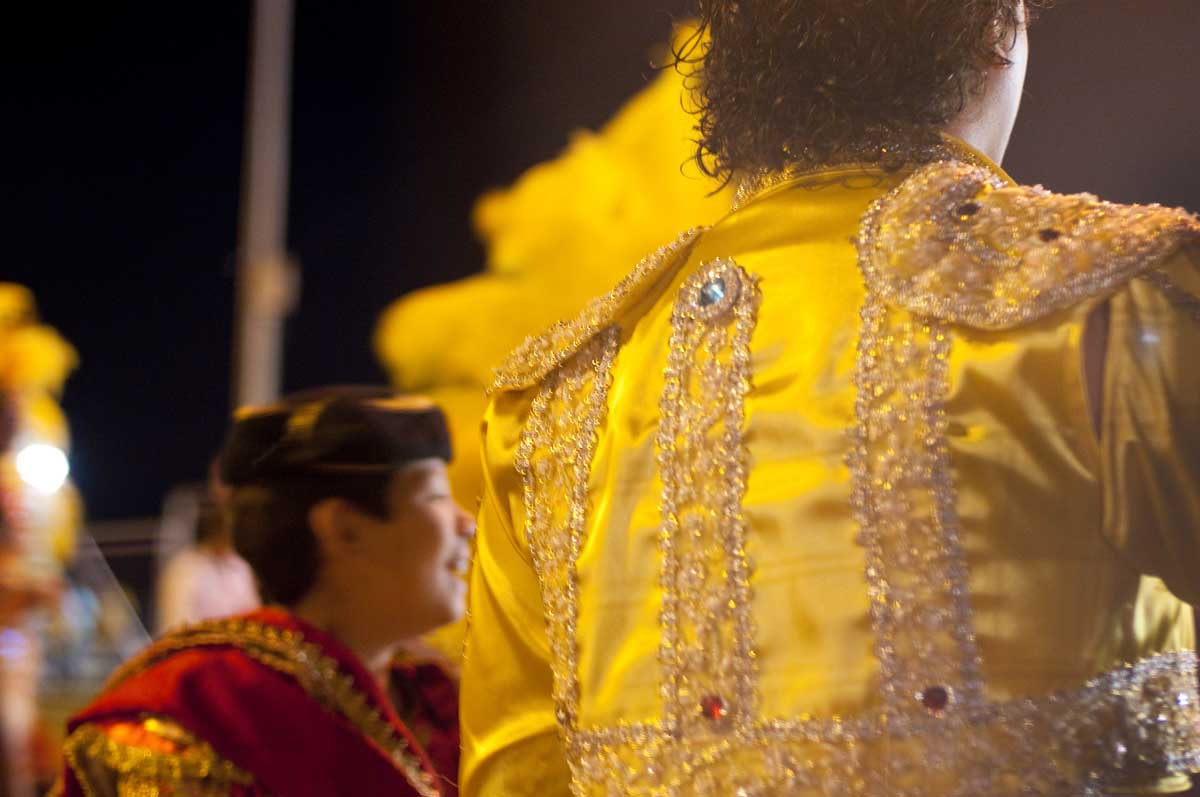
Feathers and Foam and Dancing girls... Oh My!


Time moves differently down here. Phone tag that starts on Monday feels like a full month passes until it catches up on Thursday. Events from early January feel like just moments ago all the way into mid-March. Between the flip in seasons and an irregular schedule, my internal clock needs a serious tune up. Following this, I can’t hardly believe that Encarnacion’s Carnaval threw its final water balloon over three weeks ago. 

Home to the biggest celebration in the country, Encarnacion considers itself the Capital of Carnaval in Paraguay. Other cities host festivals and parades throughout the season, but none party like this southern border town.

Carnaval arrived in Encarnacion (or Encarn as most volunteers call it) with the railroad, in 1916. Originally a three day celebration leading up to Ash Wednesday, today Encarnacenos paint the town red for the entire month leading up to Lent. Friday and Saturday nights Rey Momo (King Momo) leads the corsos (parade route) through blocks of brightly lit bleachers along the waterfront. Sundays, the entire city becomes fair game for a no-holds-barred water fight. Kids run through the streets with buckets of water and full balloons, older participants launch their watery weapons from moving cars.

As Kevin and I walked to the bus with our tickets in hand, I had no idea how our first night at Carnaval would unfold.  Would we encounter a mild-mannered evening where men and women sit opposite each other without speaking (not an uncommon set-up for a Paraguayan get-together) or a modern day Sodom and Gomorrah, with free-flowing alcohol and wild crowds?  I wavered between basing my expectations on the Mardi Gras themed beers ads who found their inspiration here and listening to my host mother remind me how Paraguay’s deep Catholicism prevents activities from escalating above a PG rating.  (An insistence, I should mention, that becomes a little farther from the truth for me daily--but more on this later.)  The event ends with the start of Lent thus making the connection between the party and the church undeniable, but still I couldn’t get the image of feathers and dancing girls out of my head.


Admittedly, I counted myself among those with mixed feelings about a shindig that supposedly centered around half naked women shaking their heavily glittered bottoms for the eager hoards.  A few minutes into the parade, however, and these reservations disappeared.  Of course some took the night as an excuse to drink to excess, I quickly recognized the true essence of the occasion in the Samba beat.

Organized through neighborhood commissions and social clubs, everyone dances--regardless if in the spotlight or in the stands.  The biggest associations have themed floats, bands, drum-lines, multiple sections of dancers, and a children’s division.  Although most adult dancers wore a little less than your typical ballerina, few looked truly scandalous.  
The little girls (in leotards and tights) aligned with various organizations held their heads higher than I’ve yet seen in this country.  (The United States and Paraguay hold generally differing views on fostering self-esteem in children.) Overwhelmed by the pride of the proceedings and unable to resist the foam fight, I can't wait until next year.  Long Live Carnaval.


For an entirely different type of Paraguayan Carnaval, please click here to read Discovering Paraguay's account of festivities in the Chaco


Sunday, February 19, 2012

"You are not the father..."

Meet Mima
Last week the cat next door had four kittens, each spotted black and white with fat little tummies.  A few days after the birth, Kevin and I had our very own Maury Povich moment right here in Paraguay.

Neighbor: Your cat fathered the litter.
Me: Um, I’m pretty sure our cat’s female.
Her: Really?  Tell me about the cat’s nipples.
Me: Well, she has them.
Her: Okay.

Evidently in my neighborhood, cat nipples can break paternity cases.  And to think I spent all that time googling feline genitalia to determine our cat’s gender.

During service, many Peace Corps volunteers get pets.  A handful of these cats and dogs make their way back to the States.  Others get passed on to new Gs.  Some move into the care of Paraguayan friends.  Early on, people asked us if we planned to get pets during our time here--especially when they learned our history of fostering animals back at home.  In fact, for every Paraguayan that asked about when we would get started on making babies, an American asked us about furry children.  Officially, we did not plan on getting a pet during our service.  Animals complicate things and we’d rather not have to worry about caring for a cat or a dog.

We never stood a chance.

On our third night sleeping in our brand new suburban house, still relishing in our rediscovered freedom, we shot up out of a 2am sound slumber to a racket outside our front door.  Once we determined the low statistical probability of a bobcat and a hog wrestling in our patio, we realized one of the neighborhood cats chose our yard to entertain visitors while in heat.

In the weeks that followed, one of the cats drawn to our home that evening gradually moved closer and closer to our kitchen door.  She ran whenever we got too close, but she always came back.  Everything changed the night our host family mother brought us a basket of ham biscuits.  While holding a piece in my right hand, a meowing blur ran up and ate it directly from my fingers.  The following morning Kevin came home from the market with cat food, “just in case.”

Like I said, we never stood a chance. 

As she got progressively more comfortable with us, we watched her belly grow and debated if that fateful night would make her a mommy or if gorging on third helpings at breakfast led to a swollen stomach.  We made her a cozy outdoor bed and started calling her Mima--because we spoil her.
Kevin and Mima
As I’ve mentioned before, life in Paraguay changes and becomes more “western” daily.  This rapid transformation includes people’s attitudes towards pets.  Like many agrarian societies, for years animals stayed outside.  You might train a dog to guard your property, but not to sleep at the foot of your bed.

Recently, though, many Paraguayans have started to adopt animals for companionship.  Often a family will have one or two dogs for protection and another--usually of the fluffy variety--that gets to come inside.  Dog collars and toys have become increasingly available and our neighbor’s cat has her very own ball.  (I still have yet to see official cat toys for sale anywhere in this country.)   Back in our training community, every day we walked by a Weimaraner who wore a red shirt in the morning and changed into a black and white Olympia fĆŗtbol jersey after siesta.  However, just as with any culture-wide behavioral modification, a period of transition--and confusion--persists.

A few months back, while sharing dinner on the patio of a restaurant in CaazapĆ” with a group of other volunteers, we heard the unmistakable sound of a dog and a car meeting in the street.  A teensy thing, this dog howled for at least two full minutes.  As he made his way toward us, I braced for the worst.  Would he have bones sticking out?  Would he have a broken jaw?  I almost couldn’t look.  When I finally peaked through my covered eyes, I realized that this lucky and scared pup erred on the side of the dramatic.  He and the car never made contact.

Once the little fur-ball stopped crying, he started scanning the sidewalk for an area of refuge.  As soon as he met our collective gaze, he ran over and hid himself under our table--shivering and batting his pitiful eyes.  Moments later, the driver of the car spotted his tail and rushed over to check on him.  The dog, recognizing his newly acquired nemesis, adamantly refused to come out and let the woman look him over. 

After some back and forth, the driver’s companion suggested something about the dog needing water.  I so clearly remember smiling to myself and thinking, “How sweet.”  Mistake number one.  The driver slipped into the restaurant’s kitchen and returned with a tall pitcher of water.  At this point, I recall two simultaneous thoughts: One, how might the dog manage to drink from that?  Two, did the other lady use this same pitcher to fill our water glasses?  Second mistake. 

Next thing we know, the woman starts throwing water at the dog.  Mind you, the dog, still refusing to change positions, has hunkered down around our ankles.  Every time this woman attempted to splash the dog, she soaked us.  Unfazed, the dog (heretofore referred to as the most stubborn dog in existence or TMSDIE) continued his stand-fast under our table.  Clearly having missed the day at school that covered creative problem solving, the woman persisted, undeterred by her lack of success, to heave the now semi-full pitcher of water in our general direction.  After drenching all of our shoes (and one friend's pant leg), she eventually grew tired of this strategy (more likely ran out of water) and grabbed a broom to shoo TMSDIE across the street.  With her mission accomplished, she turned and smiled at us proudly.  We stared back baffled and slightly horror struck.

Our group laughed about this woman and TMSDIE for the rest of the weekend.  On the one hand, the experience felt surreal.  Yet on the other, it felt like just another Thursday night in Paraguay.  Every day I find myself caught in a moment or conversation that feels completely familiar--so much so that I forget what continent we now live on.  These split seconds, though, usually get interrupted by something completely off the rails.

With increased industrialization, the farther and fewer these instances will occur.  Similar to the dogs who don’t quite understand their role anymore, I too feel caught in the middle and conflicted by changes that accompany development.  I like Paraguay like this--and not for the novelty of odd stories.  I could come up with a litany of little aggravations, but most of the time I find myself charmed.  Time will reveal if Paraguay maintains its sense of self as it emerges in the global market; the consideration of pets sits just on the tip of the iceberg.

I only hope that terere doesn’t get lost in the shuffle--even if it means buying pre-fabricated yuyo (herb) packs and pre-flavored yerba.  (Both available at our local market.)  For now, though, I’ll stick to worrying about the demands of keeping a certain someone’s food dish full.

Standard summertime pose

Friday, February 3, 2012

Thinking Smaller

Volleyball at dusk

I’ve spent a lot of my time as a Peace Corps volunteer struggling.  I struggle with language.  I struggle with finding my place in my community.  I struggle with maintaining relationships back home.  I struggle with finding projects and people to work with.  Then I struggle with sustainability.  I struggle with what comes next.  Inherent to the Peace Corps experience, every volunteer I meet struggles with something--more often, many things.
Ready for another icebreaker?

A recent RPCV reflected in her blog that as an organization Peace Corps finds success in teaching us how to fail.  When you grow up playing on soccer teams that don’t keep score, you don’t always learn how to deal with rejection gracefully.  And Peace Corps volunteers face constant rejection and failure.  We interview our neighbors about their needs and when we set up trainings to meet those needs nobody comes--even when the whole town promises that they’ll attend.  We facilitate the foundation of a much anticipated community group and meeting attendance nose drives after the third gathering.  The sit-down your community contact agreed to during your first few days in town gets pushed back weekly.

Over and over again we tell ourselves, “you only need to reach one.”

During training, our country director shared the story of a pair of volunteers serving together in the early 1960s who reached one: Alejandro Toledo.  As in former Peruvian president Alejandro Toledo.  Born into extreme poverty, he ended up with a PHD from Stanford.  A potential reached, he frequently explains, through the support and guidance of Peace Corps volunteers.

When you reach one, they reach others.  Alejandro Toledo reached millions.

I have no intention of holding myself to the standards set by Nancy Deeds and Joel Meister, arguably some of the most effective Peace Corps volunteers in the history of the program.  I do, though, try to place my focus on reaching just one and celebrating small wins.

"Who will change the world?"
This past week, many members of our sector (Community Economic Development) got to reach just one as a group.  Ƒande Ha’e TenonderĆ£ (We Are the Future) Leadership Camp gathered almost thirty volunteers with seventy Paraguayans between the ages of fourteen and twenty-four to share four days of leadership, development, and self-esteem training.  Youth participated in seminars presented by various Paraguayan NGOs, engaged in many team-building exercises, and partook in countless icebreakers.

Opening night charlas

Teatro'i and creative problem solving
In our final activity, the youth formed two circles, one inside of the other.  While the inner circle stood with their eyes closed, the outer circle walked around them and responded to a series of questions by touching members of the inner circle on the shoulder.  “Who made you laugh this week?... Who changed your mind about something this week?... Who will change the world?” 

By the end of the exercise, many of the youth could not contain their tears.  Many of the volunteers could not contain their satisfied smiles.  The camp meant something--something maybe even life changing--to these kids.  They met, they exchanged ideas, and they realized that they really could change their worlds.  The volunteers didn’t create any of it, we just supplied the tools these youth needed to get there on their own.

Early morning Taekwando
Only in Paraguay... do harps make the summer camp packing list
I had personal goals for each of our kids.  I hoped our fourteen year old would gain a new perspective while seeing more of Paraguay, our fifteen year old would start to realize his own leadership potential and gain some organizational skills, and our sixteen year old would connect with like minded individuals and learn that others share his dream for his country.  All of them grew more in four days than I knew possible.

Introducing s'mores to Paraguay

A train of excited jovenes pulls into the CaaguazĆŗ bus terminal
As we left camp, the kids sang and danced in the CaaguazĆŗ terminal and promised to keep in touch.  They made plans for our re-connect camp in July and confirmed everyone’s name on Facebook.  I started to question if we’d ever manage to herd them all on to buses.  Eventually, the southern contingency made our way onto a packed double decker headed back towards the capital.  Little did I know, on the way home from camp I would reach one of my personal goals too. 

Standing in the aisle and pressed against strangers, our fourteen year old surrendered to motion sickness all over herself, me, and another man.  Surprisingly, no one got up to offer her a seat.  In fact, no one seemed all that put off by the incident.  About twenty minutes later the seat next to where we stood opened up.  As I ushered my youth toward it, a young man tried to sneak in. 

Now, we’ve all heard the story about the mother, who upon seeing her toddler stuck under the wheel of a car, summons the strength to lift the vehicle and pull her kid to safety.  My “(substitute) mom” adrenaline came in a different form: without thinking, I grabbed this teen by the waist, pulled him from the seat, and plainly explained to him why he’d have to stand for just a little longer.  Evidently I have picked up a little Spanish along the way after all.  (Of course my body language could have had a lot to do with my clarity, but this still counts as a victory.)

Later that night, around 9:30pm while our youngest slept off her nausea, I got to do some eavesdropping.  Nearly nine hours into our journey and still an hour and a half from home, in a pitch dark bus surrounded by dozing strangers, our fifteen and sixteen year old started planning a project that would ultimately benefit our entire community.  They even considered logistical issues regarding reaching our most isolated rural areas.  To call myself proud wouldn’t even begin to cover it.

When we finally reached the entrance to our town, the boys excitedly bounced ideas off each other as we walked the two kilometers back from the main route.  Our fourteen year old, still not quite yet awake held back, half listening.  Worried that a rough bus ride sullied her camp experience, as we approached her house I asked her, “Did you miss our town?”  “A little,” she replied.  “But I miss camp more.”
Over the next few months, I can’t wait to see where this new-found enthusiasm takes them--even if it means struggling to get our camp’s theme song out of my head.  Aaaaaaaauuuuuuuuttttoooo-estima....

"Auto-estima, no se puede comprar. Auto-estima, viene de adentro...."
"Self-esteem, you can't buy it.  Self esteem, it comes from within...."
The Southern Contingency: On Wednesday, we left before sunrise.  At 4:45am we collected the kids from each of their houses and exchanged goodbye kisses with their mothers.  In the dark of early morning, we could barely make out their expressions.  Excitement?  Fear?  Two thirds of our youth had never before traveled without parent and yet they headed halfway across the country with two Nortes who possess only limited Spanish.  Around 11pm the following Saturday we returned everyone safe, sound, and ready to work.

Kevin, Vero, Damian, Joanna, and Luis

Tuesday, January 24, 2012

Turning the Page on a New Year

January has always felt like a natural time to reflect.  With a new year passing, something about the cold and ice and snow always inspires a little nostalgia in me.  Although January in Paraguay hardly includes snow and the only ice I see rapidly melts in our terere pitcher, I’ve still spent sometime looking back over the past few weeks.

I have a lot to give thanks for.  Plain and simple, this year my dream came true.  As many of your know--and some can relate to--this dream took a long time to realize.  Frankly, it took longer to realize that I ever expected it could

I started regularly thinking about joining the Peace Corps in the early 1990s.  Yes, my Peace Corps fantasy began when some of my current co-workers spent their days in diapers.  By the time I hit the age where most people start the application process, I already thought my chance had passed me by.  It took years to reengage that dream, further more to make it a reality.

This shouldn’t surprise me, though.  I’ve always come to things a little off schedule.  Whether early (at 11 I swear I heard about my “maturity” on a daily basis) or late (we do not need to discuss the space between my first and final day of college), I rarely make it places right on time.  Lucky for me (and unfortunate for my mother), this never bothered me too much.  I’d like to think I’ve figured out how to go where the wind takes me--but still keep one foot rooted in responsibility.

But how did I get here?  Right now, in this place, as the person I have grown into.

In a word: books.  So much of the person I am today I owe to books.

From a very early age books taught me that the entire world--a world far beyond on the one we see with our eyes and touch with our fingers--lies at our feet.  We hold our destinies in our own hands and we may choose the paths we follow.  We need not travel in anyone else’s footsteps--though we may find inspiration there. 

My earliest memories include my mother and a book.  She always found the time (while working full-time) to read me stories.  I feel grateful that I grew up with books of my own.  In fact, I had an entire bookshelf full of precious, wonderful books that I could look at and hold whenever I wanted.  I even grew up with a library in my town and at my school.  Not only did I get to explore rows upon rows of books, but I had a card with my name on it that allowed me to take my favorites home for a couple weeks at a time.  Through those pages I learned to care for the books themselves, valuing them as objects and for the stories the held.

During my ugliest teenage years my father, who does not usually express his feelings to me directly, would search through Borders to buy me books he thought I would like.  His choices told me how well he actually paid attention during a time when I didn’t think he noticed me at all.  He may not have always agreed with me, but he always gave me the option to arrive at decisions on my own.  Neither he nor my mother censored my literary exploration.  They encouraged me to find my own way and never expected me to mirror their opinions.  As an adult my parents and I hold many differing views and some of the same.  I know that the beliefs I hold are my own and formed through thorough personal investigation.

Even far away, I love that my nephews let me read to them, giving us time--silly and quiet--to share.  I ache for the day when we can sit together again and hope a certain eight month old likes to hear stories as well.

Not only have books given me special time with the people I care about, but they opened my eyes to a whole world of possibilities.  Through books, I learned that my life could turn into whatever I imagined, rather than the resonable and obvious possibilities that laid out before me.  Books gave me imagination and showed me a world so much grander than the one in my immediate reach.  I believe in impossible things because I read about them.

Most Paraguayan children do not grow up with this same gift.  Often, publishers and distributors price books far beyond the reach of average people and institutions.  Libraries and schools that can afford to build a collection, rarely lend them out.  When another volunteer suggested that her library move the children’s section from the top shelf (at eye level for an adult) to the bottom shelf, her supervisor replied, “No.  Then the children will be able to reach them.” 

Paraguay reports a 94% literacy rate.  However, I’ve heard that 47% of Paraguayans do not read above a fifth grade level.  Meanwhile, according to the 2010 GDP, the average Paraguayan makes $433 USD/month.  (Given the way authorities calculate this figure, most Paraguayans probably make much less.)  Budgets leave little wiggle room and usually books do not make the cut.  Children whose parents do not read, often do not read well themselves.  We see the same thing in the States.  Reading begets more reading.

Accordingly, many Peace Corps volunteers embark on literacy and library projects.  Volunteers not only read stories and teach the fundamentals of reading, they explain the basics of books.  By not growing up with books, often children do not understand how to treat them well.  At a recent workshop, volunteers learned how to teach kids to turn pages.  Missing this steps often leads to wrecked materials.

Although our story hour will not formally begin until March, we practice on the neighbors.  One afternoon we read the same story about a dragon with a cold three times--in a row.  If we meet half the enthusiasm of our practice run in the classroom, I’ll still call it a win.
 
Special thanks to the marms for starting our library.  Wendy, Kathy D, Martha, Nancy, Ev, Carol, Mary, Peggy, and Kathy S.: Your kindness and generosity have opened up a new world of possibilities for the children in our town.  Thank you.

Tuesday, January 17, 2012

And there won't be snow in Paraguay this Christmas time

Or in the rest of the Southern Hemisphere.  Expect for Antarctica.  Or on top of mountains.  Or maybe near glaciers.

Do they know it’s Christmas Time at all?

Unlike the area of the world that inspired the 1984 hit, 90% of Paraguayans identity themselves as Catholic and another 7% as Protestant or other Christian.  That only leaves a very small percentage of people who might not know it’s Christmas time, but I doubt they missed the memo.  Around the second week of December lights and nativity sets started popping up in yards, living rooms, and town plazas.

Nativity Scene in Coronel Bogodo's central plaza.  Note the stork, upper left.
Typical in-home nativity scene.  Some families have artificial trees, more gather branches and build a set.
Oh, I shouldn’t pick on Bob Geldof too much.  His crew did manage to raise a whole pile of money for famine relief.  Plus, triple digit heat didn’t sound too much like Christmas time to me either.

In a way, I felt grateful for the high temperatures.  Of course I understand full well that most of the world rings in the New Year without snow.  However, with the exception of a few freak warm days, the December I remember requires boots, heavy coats, and may include a lit fireplace.  Thanks to the soaring temperatures, I kept forgetting the month. 

In the weeks leading up to Thanksgiving, I started to feel the distance.  Serving as a married couple, Kevin and I came to Paraguay as a family.  For as many people as we left behind, we have each other.  Of course constant companionship presents is own issues, loneliness hardly makes the list.

I hadn’t truly felt “away” until I started thinking about Christmas.  2011 marked the first year I didn’t make it home for the holidays.  I don’t know if it was actual sadness or more the stress of anticipating sadness that made things tough.  Some days I felt like everyone expected me to break down.  (Host mom: “You must miss your mother so much.”  Me: “Yes, I do.”  What does that have to do with you passing me the rice?)

Either way, we decided to embrace the difference and host a Mexican Christmas dinner in our tiny southern town.  Using Paraguayan ingredients and shipped-in spices we shared enchiladas, tacos, and margaritas (made with lime flavored tang) with four other volunteers.

Chorizo anyone?
In Paraguay, Christmas Day matters far less than the night before.  Our host family agreed to “let us” have Christmas Day at our home, but did not give us a choice for Christmas Eve.  Since our host mom started pressuring us about this back in October, I recognized the futileness in fighting her on this particular issue.  We worked out our plan: Christmas Eve we would bring our friends to family dinner, Christmas Day we’d stay home and cook for ourselves, and New Year’s Eve we’d return for asado.

Most of our pals arrived on Christmas Eve eve, barely beating the rain.  In the middle of a drought, no one complains about a good storm.  At the same time, rain complicates everything.  Our mostly dirt road town becomes practically impossible to navigate after a downpour.  Add water to streets already torn up from the ongoing process of installing running water and you have mud canals.

Rain might cancel school and work, but we wouldn’t see December 24th for another year and so we trudged through the destroyed streets to our host brother’s home for a traditional Paraguayan celebration.  We hosed off in the yard before entering the house.

The party started late, folks didn’t start arriving until after 9pm.  We watched Brazilian Christmas cartoons and listened to our friend get worked over about finding a Paraguayan husband.  At one point my deeply religious sister-in-law (one of my favorite people in Paraguay) asked this group of mostly atheists point blank if they believed in the virgin birth.  In the spirit of Christmas miracles, everyone awkwardly answered “yes”.

By 10pm, we started passing around chorizo (think smoked sausage rather than the spicy, crumbly stuff) and Sopa Paraguaya.  Around 11pm dinner started with asado and salad and finished with mixed fruit.  We brought a lasagna, but our sister-in-law’s father explained that since it lacked meat, he wouldn’t try any.  At midnight the bombas (firecrackers) began and we all exchanged hugs and kisses.

Around 1am a dance party started in our town center, lasting most of the night.  Also, around 1am nearly about half of our little group got sick.  Within the next twenty-four hours each of us spent some time feeling like garbage.

Tortillas and terere.

Frying tortillas and preparing enchiladas.
The following day, another friend arrived in town and our Mexican Christmas feast began.  We took turns napping and cooking and skyping the States and petting the cat.  It didn’t feel like Christmas, but it felt right.  Even with one nasty summer cold, two cases of heat exhaustion, and assorted hangovers I wouldn’t have wanted our first Christmas in South America any other way.  It didn’t hurt that my favorite two year old brought me handpicked flowers in the morning, either.

Refried beans with pineapple salsa.
Isn't all that "frutricion" supposed to prevent hangovers?

 Upon reaching our host family’s house on New Year’s Eve, I immediately received “the look” from my host mom.  By now, I have developed a sort of immunity to these looks, but I could not help but wonder where the problem lie this time.  We presented ourselves on time and I even put lipstick on.  

Within the hour, though, I found myself unfortunately underdressed.  For a BBQ in the backyard, my sister-in-laws both wore cocktail dresses and all the boys dressed in pressed ao poi.  These days, my finest duds amount to ironed jeans and a button down blouse.  Luckily, my outfit didn’t cause too much sensation.

Our dinner menu looked like every other asado we’ve attended: beef ribs and pork done on the grill, Sopa Paraguaya (an unsweetened cousin to cornbread), sliced tomatoes and cucumbers with vinegar, and rice salad (white rice mixed with carrots, peas, red onions, and mayonnaise).  

For the occassion, some families make a sangria-style drink called clarico.  However, in our family, the men drank beer and the ladies and children shared Fanta and Coke.  Before and after dinner, the kids lit off firecrackers in the front yard.

Well dressed boys showing off their firecrackers.

Just before midnight, we gathered in the living room to countdown.  Just like everywhere else in the world, when the clock struck twelve we exchanged hugs and kisses.  Unlike everywhere else in the world, we then changed Baby Jesus’ cape and retired to the back yard to eat twelve grapes for a lucky 2012.  Our host brother lit off a true firework, filling the sky above the house with a momentary glowing ring.

New clothes for a new year.

Less than a week later, the final event of the Paraguayan Christmas season came to pass--January 6th, Three Kings Day aka The Epiphany or the day the Three Wise Men brought frankincense, myrrh, and gold to the Baby Jesus.  

Parts of Latin America make a bigger production out of this feast than others.  Throughout the region, some have parades and kids dress up as kings.  The night before many children leave out a little snack for the camels next to their shoes.  In the morning, youngsters awake to find gifts in their footwear.

In Paraguay, although we don’t host parades, many families place more importance on Three Kings than on Christmas Day.  In recent years, Santa has increased in popularity, but the 6th of January remains king.

The close of our holiday season will come on this Friday.  A Grinch called Paraguayan Customs decided to hold our holiday care-packages in what volunteers not-so-fondly refer to as "package prison".  Luckily, our wonderful coordinator has offered to liberate the boxes and send them south.  Although I’m sure our family would have preferred us to receive the gifts last month, I really don’t mind dragging the celebration out a little longer.

Our youth group Christmas party: soccer, volleyball, and snickerdoodles.
Helping our friend and fellow volunteer transport a mountain of gifts sent from the States for kids living at a local orphanage.

Thursday, December 29, 2011

Should We Talk About the Weather?

A few weeks back, while Kevin and I sat in the shade of our host family’s yard chatting about the day, a low hum started from the upper branches of the mango tree at our backs.  Our mom explained- the cicadas announce Christmas.

It turns out they brought the heat with them, too.  Summer has come to Paraguay. 

So far we’ve had a handful of days over one hundred degrees and many more in the mid-nineties.  Thick oppressive humidity weighs the air down and makes any activity difficult.  The sun feels closer here.  Between noon and 4:00pm our community turns into a ghost town.  No one braves the muggy streets, when terere (more on this soon) and shade waits at home.

I think, though, that we may have our family under the impression that we might die from the heat.  See, we talk about it a lot and when topics start to dominate conversations certain assumptions arise.  This, however, may actually indicate a bit a cultural integration. 

In Paraguay, we dance around things.  We do not ask for things directly and folks receive requests for explanations of a project or idea as outright criticism.  (Possible exceptions include inquiries to volunteers regarding level of belief in virgin birth, volume of meat consumed, and the choice to wear those pants when they clearly need ironing.)

For example, last week we held a small Christmas party for our youth group at a soccer field next to our town’s central plaza.  In preparation we needed to submit a request to use the area.  As an American, my instinct suggested I walk into the mayor’s office and ask.  The whole process should have taken five minutes maximum.

Instead, we spent over an hour discussing the heat over terere.  Of course the conversation turned in different directions through its natural course, but every time a new person entered the room we returned to the weather.  Eventually, we got around to the impending party and not only scored the space, but a neighbor lent us a volleyball set as well.  The business portion of our visit to the municipality lasted about three minutes.  The trip, however, took all morning.

Every interaction here starts with the weather.  As we assimilate to Paraguayan culture the percentage of our conversations involving the climate increase.  Understandably, this confuses those back home.  Generally, people in the United States (at least in urban settings) do not spend significant time discussing meteorological conditions.  It may come up, but conversations do not center around the topic.  In Paraguay, we discuss the temperature at length and meander our way into more pressing issues.  Only the very rude jump right into business talk. 

As a result, I think our family now worries that we might actually melt. 

(Full disclosure: Not too long ago I also shared this concern- especially early on in spring when I soaked through my shirt while surrounded by dry locals wearing cardigans on an eighty-nine degree day.  Of course, some of this sweat could have been fear sweat, as upon seeing longing sleeves I panicked about future thermometer readings if nearing ninety still meant sweater weather.  Thankfully, my body’s tolerance to resist sweating, although still not on par with my neighbors, has improved since that afternoon.)

Their concern makes sense.  In the United States we prioritize.  If someone spends most of an international phone call talking about how hot they feel, this heat must really bother them.  In Paraguay, we talk about the temperature to warm up to the real exchange.

I’ve heard that when one's second language skills get stronger, they have an easier time switching between their native and new tongues.  During the process, though, often words from one source slip into conversations held in the other.  Regularly, Kevin and I unconsciously pepper our english with spanish verbs.
Perhaps the same concept holds true for cultural integration.  Even as Paraguay starts to feel like home, my sense of self as an American grows.  Sometimes South America makes me feel more like a North American than I ever did back home.  Contrast highlights the difference.  I know that this experience will change me, but for now my two worlds have mixed together.  I don't yet know how to move back and forth between the two.

Friday, December 16, 2011

The Fourth Goal

In an effort to support one of our favorite Peace Corps Paraguay extra-circulars, this past weekend Kevin and I once again traveled the length of Ruta 1 back to Asuncion.

Ahendu Paraguay (Guarani for "I hear Paraguay”) takes place three times a year and features solo and group performances from Peace Corps Paraguay volunteers, KOICA volunteers (Korea International Cooperation Agency, aka the Korean Peace Corps), and Paraguayans.  Musicians and music appreciators alike gather for an evening to connect through song and a few drinks.

KOICA volunteers warm up.

The dancing starts when the sun goes down.
Not every participant in Ahendu played an instrument before arriving in Paraguay.  Transitioning from our overbooked and overstimulated lives in the States to a country where during the summer months no one leaves their home between 11am and 4pm and in the winter small towns roll up their metaphorical sidewalks before 5:30pm, leaves many volunteers, well, bored.

To clarify, signing up for Peace Corps means agreeing to work seven days a week, twenty-four hours a day.  This does not mean that we do round-the-clock traditional “work”, constantly running charlas or youth groups.  Rather, we spend our days on display.  Integrating into a new culture drains you.  Even those who already speak the language still need to adjust to different foods, climate, lifestyle, living away from friends and family, and near complete loss of privacy.  (Our neighbor has even gone so far as to report what we prepare for dinner back to our host family.)  We try to fill our days supporting our communities in meeting their training needs (Peace Corps goal one) and exhausting opportunities for cross-cultural exchange- educating Paraguayans about the US and vice versa (Peace Corps goals two and three), but we always have time left over.  Many volunteers crave projects to fill this time and decompress from the pressures of the day.  As such, fourth goals start to emerge.  Long stressful days without typical American distractions encourage- nay, require- hobbies. 

Some volunteers get pets during their service, others become exercise fanatics.  Almost everyone reads.  Even Kevin, who hasn’t picked up a book in years, has already finished eleven novels- including a Steinbeck.  I spend the hotter-than-the-surface-of-the-sun afternoons perfecting my Paraguayan finger wag.  (More on this later.)  I also spend some time working in CS4.  (Who would think that moving to a third world developing nation would actually improve my technology skills- even if everyone else has moved on to CS5.)  Kevin spends much of his unscheduled time working chords and scales on his classical guitar- of course manufactured in Luque, the center of Paraguayan guitar making.

Perhaps more than other Peace Corps posts, Paraguay creates musicians.  A lucky side effect of isolationism, this country has a strong and unique craft heritage.  Paraguayan folk music sounds as distinctive as ao’poi looks.  Some of the greats make Lindsey Buckingham seem like a hack.  Although many people associate this tradition with the harp, Paraguayan parties do not start without a guitar.  Whether polka or reggaeton, every party I’ve attended thus far starts when the music does.

On one of our first nights in country, our host mother invited a decent portion of the extended family over to meet us.  We could barely speak the language and felt so tired from training that we could hardly keep our eyes open, but we stayed up with the family for hours.  Upon hearing that Kevin played, our brother-in-law near instantaneously produced a guitar.  Kevin fooled around for a few moments until our sister suggested she preform a little something.  Next thing we knew, the room divided into two part harmony and the most beautiful music filled the air.  Guarani has a melodious quality when spoken that naturally translates into song.  That night Kevin set his sights on learning a ballad in the indigenous language of this land.  I’ve set my sights on understanding it- michimi.

Country Director Don Clark takes the stage for early arrivals.