
Saturday, April 28, 2012
Thank You for Your Support
Special thanks to the nice people over at Wanderlust and Lipstick for including an extended version of my holiday season rundown in the "Tales" section. For all the details on hosting an American-style Thanksgiving in Paraguay, please click here.
Thursday, April 5, 2012
I’ll Never Take Score Again or The Trouble With Democracy
 I now completely understand elementary school sporting leagues who do not keep score. Please strike any of my previously snarky comments from the record with my deepest apologies.
I’ve heard parents liken having children to allowing your heart to walk around outside your body. Although I have no children of my own, I understand this sentiment increasingly-every day with our kids from youth group. When they have a good day, I feel great. When I see them struggle, I wish I could feel the frustration for them. And most of all, when I see them try something new--push themselves and embrace something outside their comfort zone--I feel overwhelmingly proud.
I would not describe Paraguay as a nation of risk takers. Culturally folks tend to stick to what they know. Whether dinner, professional paths, or gender roles, although exceptions spring up regularly, for the most part people here stick to what traditionally works and don’t venture into the unknown. (You might remember me having to bully my host mother in Ita into trying peanut butter with chocolate.)
Although this could spark a chicken or the egg debate, I attribute a lot of this attitude to the Paraguayan school system. When teachers follow a curriculum designed towards a test and center study on the answer key, a nation runs the risk of raising a generation focused on getting the right response--as opposed to the process of learning, critical thinking. Accordingly, most of the kids we work with have such deep fear about getting things wrong that if they can’t do something perfectly, they won’t try it. I’ve stopped counting how many times a kid has called me over during a lesson on self-esteem to approve their reply to a question about their feelings. I never expected the concept of “no wrong answers” to cause such trouble.

Eager to validate their presence in the community, last week our youth group held elections--and it nearly ripped my heart in two. Six of our kids stood up announced their intentions to run for the offices of President, Secretary, and Treasurer. The runner-up to the presidency would serve as vice-president, the others would form an executive committee. While I felt no surprise certain individuals declared their candidacy, when one of the quietest kids threw her hat in the ring I felt a lightness in my chest.
Among our most dedicated participants, she has an almost painful shyness about her. Her thirteen year old fingers shook she gave a speech to her peers highlighting her qualifications. She made herself vulnerable in a way most of her classmates wouldn’t dare.
In an effort to promote transparency in a country often labeled the most corrupt in South America, we counted the votes out loud in front of everyone immediately after voting. As we sorted the ballots, her opponent (also a great kid but less prepared for the position) started to pass her and a pit formed in my gut. In the end, he received the same number of yeses as he had cousins the in group.
In an effort to promote transparency in a country often labeled the most corrupt in South America, we counted the votes out loud in front of everyone immediately after voting. As we sorted the ballots, her opponent (also a great kid but less prepared for the position) started to pass her and a pit formed in my gut. In the end, he received the same number of yeses as he had cousins the in group.
She appeared visibly crushed. After, she asked me to sit with her and her best friend to talk it out. Even though she giggled as we said goodbye, I couldn’t quite tell her true feelings.
Americans take risks to an almost pathological level. On one end of the spectrum, we create jobs if we don’t like the ones available. On the other, we reward the most controversial behavior with a fifteen episode run on TLC. But how often do we do the terrifying things build our character?
Our youth took the loss hard, but she came back the following week and pledged to support her former political adversary. The ache I took on as the election results rolled in grew into admiration. She tried and failed and returned with her head held high. A risky move and an example for us all.
 |
| Executive Committee |
Wednesday, March 14, 2012
Feathers and Foam and Dancing girls... Oh My!


Time moves differently down here. Phone tag that starts on Monday feels like a full month passes until it catches up on Thursday. Events from early January feel like just moments ago all the way into mid-March. Between the flip in seasons and an irregular schedule, my internal clock needs a serious tune up. Following this, I can’t hardly believe that Encarnacion’s Carnaval threw its final water balloon over three weeks ago.
Home to the biggest celebration in the country, Encarnacion considers itself the Capital of Carnaval in Paraguay. Other cities host festivals and parades throughout the season, but none party like this southern border town.
Carnaval arrived in Encarnacion (or Encarn as most volunteers call it) with the railroad, in 1916. Originally a three day celebration leading up to Ash Wednesday, today Encarnacenos paint the town red for the entire month leading up to Lent. Friday and Saturday nights Rey Momo (King Momo) leads the corsos (parade route) through blocks of brightly lit bleachers along the waterfront. Sundays, the entire city becomes fair game for a no-holds-barred water fight. Kids run through the streets with buckets of water and full balloons, older participants launch their watery weapons from moving cars.
Carnaval arrived in Encarnacion (or Encarn as most volunteers call it) with the railroad, in 1916. Originally a three day celebration leading up to Ash Wednesday, today Encarnacenos paint the town red for the entire month leading up to Lent. Friday and Saturday nights Rey Momo (King Momo) leads the corsos (parade route) through blocks of brightly lit bleachers along the waterfront. Sundays, the entire city becomes fair game for a no-holds-barred water fight. Kids run through the streets with buckets of water and full balloons, older participants launch their watery weapons from moving cars.


As Kevin and I walked to the bus with our tickets in hand, I had no idea how our first night at Carnaval would unfold. Would we encounter a mild-mannered evening where men and women sit opposite each other without speaking (not an uncommon set-up for a Paraguayan get-together) or a modern day Sodom and Gomorrah, with free-flowing alcohol and wild crowds? I wavered between basing my expectations on the Mardi Gras themed beers ads who found their inspiration here and listening to my host mother remind me how Paraguay’s deep Catholicism prevents activities from escalating above a PG rating. (An insistence, I should mention, that becomes a little farther from the truth for me daily--but more on this later.) The event ends with the start of Lent thus making the connection between the party and the church undeniable, but still I couldn’t get the image of feathers and dancing girls out of my head.


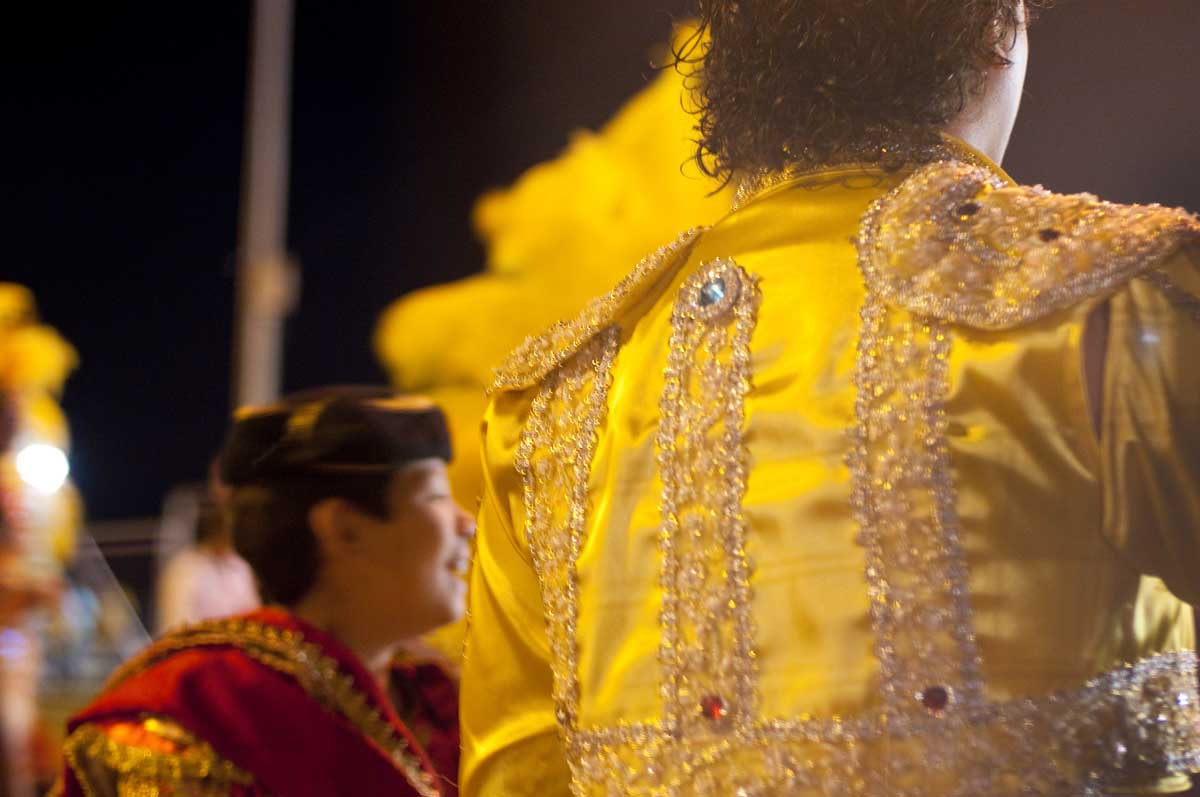
Admittedly, I counted myself among those with mixed feelings about a shindig that supposedly centered around half naked women shaking their heavily glittered bottoms for the eager hoards. A few minutes into the parade, however, and these reservations disappeared. Of course some took the night as an excuse to drink to excess, I quickly recognized the true essence of the occasion in the Samba beat.


Organized through neighborhood commissions and social clubs, everyone dances--regardless if in the spotlight or in the stands. The biggest associations have themed floats, bands, drum-lines, multiple sections of dancers, and a children’s division. Although most adult dancers wore a little less than your typical ballerina, few looked truly scandalous.


The little girls (in leotards and tights) aligned with various organizations held their heads higher than I’ve yet seen in this country. (The United States and Paraguay hold generally differing views on fostering self-esteem in children.) Overwhelmed by the pride of the proceedings and unable to resist the foam fight, I can't wait until next year. Long Live Carnaval.
For an entirely different type of Paraguayan Carnaval, please click here to read Discovering Paraguay's account of festivities in the Chaco.


Subscribe to:
Posts (Atom)